
I think a lot of people fail to understand how deeply modern science and ancient eastern thought align. It’s not just a matter of metaphor or analogy, it’s a fundamental similarity in how both disciplines describe the nature of reality. Quantum mechanics, with its emphasis on interconnectedness, observer influence, and dynamic equilibrium, echoes the core tenets of Taoist philosophy: the interplay of yin and yang, the fluidity of the Tao, and the non-dualistic view of existence. It works both ways: my personal meditations on Buddhist or Taoist thought borrow heavily from scientific revelations in physics, and I find reading about new scientific discoveries to be a profoundly spiritual experience. In essence, these are not separate diciplines in my path to understanding the universe and my place in it. All the branches of science and eastern philosophy are different pathways to deepening this understanding.
Links between Quantum Pioneers and Eastern Thought
Some of the greatest minds in quantum physics engaged with Eastern philosophy, and their insights are hard to ignore:
- Werner Heisenberg found that discussions with Indian philosophers helped him reconcile the counterintuitive aspects of quantum theory. He saw parallels between the observer effect in quantum physics and the interconnected, non-dualistic views of Eastern philosophies.
- Niels Bohr, another founding figure of quantum theory, was so inspired by the Taoist concept of yin-yang that he incorporated the symbol into his coat of arms when knighted in 1947. He believed that Eastern thought provided a philosophical framework that resonated with the findings of quantum physics.
- Erwin Schrödinger, famous for his thought experiment involving a cat in a box, was deeply influenced by Vedanta and Buddhism.
- David Bohm and Arthur Zajonc participated in dialogues with the Dalai Lama, exploring how Buddhist concepts like “emptiness” align with quantum non-locality.
- Anton Zeilinger, a Nobel laureate in quantum physics, also engaged in discussions with the Dalai Lama, reinforcing the idea that Eastern thought and quantum mechanics share a common language.
I do wonder if many advances in the contemporary understanding of our quantum world would have been possible if these great names in physics had not had a solid grounding in eastern thought.
Core Concepts
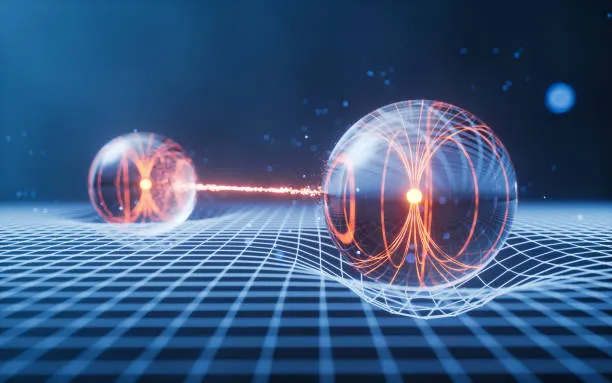
- Interconnectedness: In quantum mechanics, particles can be entangled across vast distances, reflecting the Taoist idea that all things are interconnected.
- Dynamic Equilibrium: The Taoist concept of the Tao as a flowing, ever-changing force mirrors the dynamic, probabilistic nature of quantum reality.
- Observer Influence: The role of the observer in quantum mechanics aligns with the Taoist idea that perception shapes reality.
- Non-Dualism: Both quantum physics and Taoism challenge the classical, mechanistic view of the universe, instead embracing a more fluid, holistic understanding.
A Holistic View of Reality
The conversation between physics and Taoism isn’t just academic—it’s a daily practice for me. If we accept that reality is fundamentally interconnected and dynamic, as both quantum physics and Taoism suggest, it challenges us to rethink how we approach science, spirituality, our daily lives and how we interact with the world around us. The universe isn’t a collection of isolated objects but a web of relationships. Isolated objects as we think of them in the west do not really exist without these connections.
Direct Quotes
For a parallel to the lesson of atomic theory … [we must turn] to those kinds of epistemological problems which already thinkers like the Buddha and Lao Tzu have been confronted, when trying to harmonize our position as spectators and actors in the great drama of existence.
—Niels Bohr
The general notions about human understanding … which are illustrated by discoveries in atomic physics are not in the nature of things wholly unfamiliar, wholly unheard of, or new. Even in our own culture they have a history, and in Buddhist and Hindu thought a more considerable and central place. What we shall find is an exemplification, an encouragement, and a refinement of old wisdom.
—Julius Robert Oppenheimer
The great scientific contribution in theoretical physics that has come from Japan since the last war may be an indication of a certain relationship between the basic ideas in the philosophical tradition of the Far East and the philosophical substance of quantum theory.
—Werner Heisenberg